India's top 1% holds close to 40% of the country's wealth. Here's what it takes to cross that line, and why a high income doesn't get you there on its own.
A well-paid professional in the top 5% of Indian incomes can sit surprisingly far outside the top 1% of Indian wealth. A shopkeeper who owns an appreciated commercial property outright can sit inside it. Income and net worth are measured on different ladders, and conflating them is the single most common mistake in these conversations.
Income percentiles in India have an official anchor: tax filing data published by the Central Board of Direct Taxes shows how many people declare income above various thresholds. Net worth has no equivalent. No ministry publishes a table of wealth percentile cut-offs. What exists instead is research, primarily the World Inequality Database, a Paris School of Economics project combining national accounts, tax data and surveys, along with the All India Debt and Investment Survey, India's official but dated (2018) household asset survey.
Every figure below is a research estimate, clearly sourced, not an official government statistic. Different methodologies produce different cut-offs, sometimes by 30 to 50%, which is why you'll see a range rather than one number.
The World Inequality Report 2026, produced by the World Inequality Lab, found that India's richest 10% hold around 65% of the country's total wealth, and the top 1% alone hold close to 40% of it, among the more concentrated distributions of any major economy in the world.
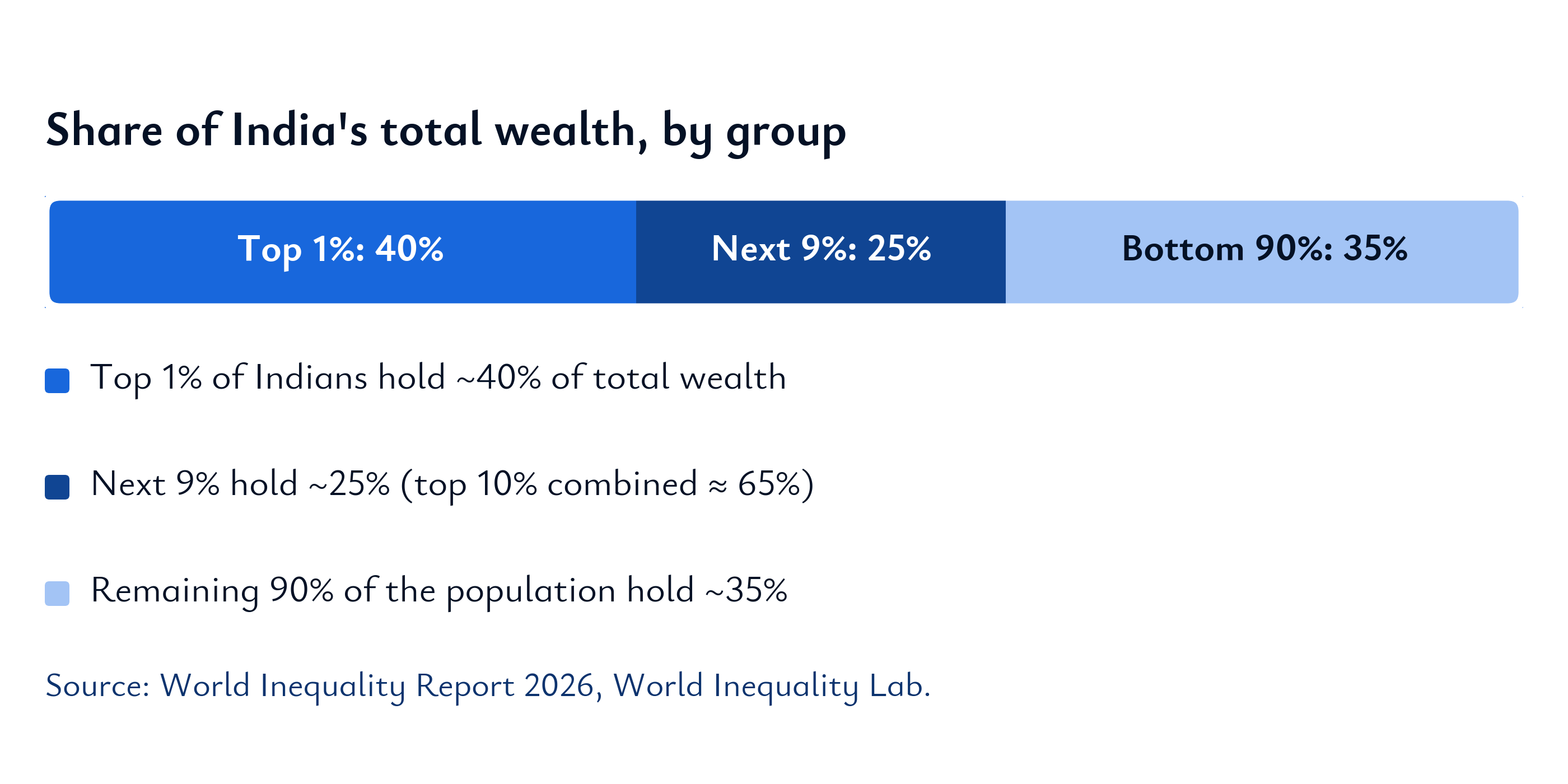
Wealth research typically measures net worth "per adult" rather than per household, which is worth keeping in mind when you compare these figures to your own family balance sheet.
India's top 10% of earners capture about 58% of national income. That's high, but nowhere near as concentrated as the 65% wealth share held by the top 10% of wealth. The gap between those two numbers is the story: wealth compounds on assets that appreciate over decades (property, equity, business ownership) while income resets every year. A high salary that isn't converted into appreciating assets stalls out well below the wealth percentile its earner might expect.
This is why a senior professional earning a top-5% income in a high cost-of-living city can sit outside the wealth top 10%, while a family that has held urban property or a family business for two generations can sit inside the wealth top 1% on a comparatively modest reported income.
Because there's no official Indian percentile calculator, the honest approach is to compare your real, current net worth (assets minus liabilities, at today's market values) against research-based bands like the ones above, while treating the comparison as directional rather than exact.
Find your real percentile position
FOLO's tools place your number against India's wealth distribution and against your peer group, and are explicit about what the underlying data can and can't support.
Where Do I Stand Among All Indians? → | See My Peer Benchmark →
No official threshold exists. Research-based estimates place it roughly at ₹1.5 to 2 crore per adult, with household-level estimates often cited closer to ₹2.5 to 3 crore, depending on methodology.
According to the World Inequality Report 2026, close to 40% of India's total wealth, with the top 10% holding around 65%.
No. Income has an official reference point via tax data; wealth does not. Every net worth percentile figure you see, including here, is a research estimate.
Research estimates put it at roughly ₹6 to 7 lakh per adult, well below the average, which is pulled up by a small, very wealthy segment.
Continue the series
FOLO is India's NetWorth app. Know your number, benchmark it, and watch it grow. Free, SEBI registered.
This article is for educational purposes and is not investment advice. Investment in securities market are subject to market risks. Wealth percentile figures are third-party research estimates, not official government statistics.