A salary adds to your net worth in a steady line. Equity adds to it in a curve, and most people misjudge which of the two they're actually on.
Two professionals, same age, same city, similar take-home pay. One works at a bank, the other at a Series C startup with a meaningful ESOP grant. On paper their net worth can look identical for years, and then diverge overnight, in either direction, the day the startup either exits or doesn't.
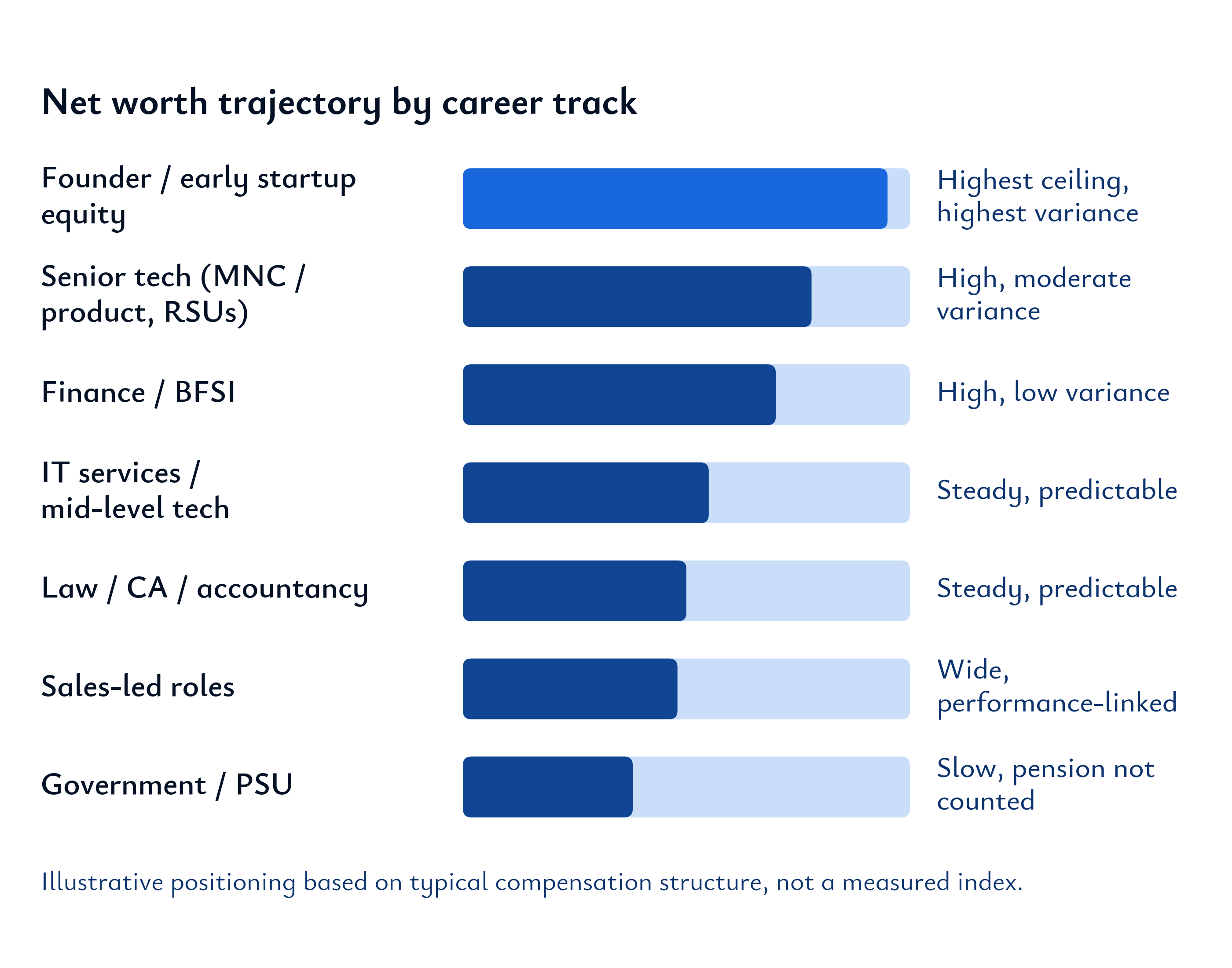
Profession shapes net worth differently than age or city do. Age and city mostly affect the pace of a fairly predictable process. Profession, increasingly, decides whether your net worth compounds on a steady line or a lumpy, high-variance curve.
No Indian dataset publishes net worth by profession. What follows is built from aggregated 2026 compensation surveys, industry ESOP research including estimates of ESOP wealth locked across India's funded startups, and published tax and dilution frameworks for how startup equity actually converts to cash. Treat every figure here as directional.
India's funded startups have created real, life-changing outcomes for early employees at companies that went on to list or get acquired. Industry estimates put tens of thousands of crores in employee stock option value locked across India's top funded startups today. But most of that is paper wealth, and paper wealth behaves nothing like cash in a bank account.
A practical way analysts size real, expected value from an ESOP grant multiplies face value by three discounts: the probability the company actually has an exit or liquidity event, a dilution factor from future funding rounds, and an after-tax factor once the perquisite tax is paid. A ₹50 lakh paper grant, run through realistic assumptions, can land in the low single-digit lakhs of expected value, a fraction of what it looks like on an offer letter.
The tax timing trap. ESOP tax in India is charged at exercise, on the spread between fair market value and strike price, as ordinary salary income, before you've sold a single share or seen any cash. Employees have had to pay tax bills running into tens of lakhs, or more, on shares they hadn't liquidated. Always model the tax event before exercising a large grant.
Government and PSU salaries typically build net worth more slowly in absolute terms than private-sector tracks. What a simple assets-minus-liabilities snapshot misses entirely is the net present value of a defined pension, a form of wealth that doesn't show up on a balance sheet but materially changes lifetime financial security. Comparing a government employee's net worth directly to a private-sector peer without adjusting for this understates the government track significantly.
Finance professionals in BFSI roles tend to build net worth on high, fairly steady cash income, often with meaningful bonus components. Law and chartered accountancy sit close to the general professional median, with net worth trajectories that depend heavily on whether the person is salaried or building an independent practice. The latter has a slower start but a much higher ceiling over 15 to 20 years.
Some of the least visible careers carry some of the steepest income curves. Actuaries are a useful example. India has only a few hundred fully qualified actuaries against a population of over a billion, and that scarcity translates into some of the highest professional salaries in the country for those who complete the exams. Similar scarcity-driven premiums exist in a handful of other specialised technical and quantitative fields.
See where your career track has actually taken your number
FOLO connects your accounts and shows your real, current net worth: cash, equity you've actually realized, and everything else, in one place.
No official dataset exists. Directionally, founders and early startup employees with meaningful equity sit furthest ahead after a liquidity event, followed by senior tech and finance roles with high steady cash pay.
Only at a steep discount, commonly 10 to 30% of face value for illiquid, unexercised grants, unless there's strong evidence of an imminent exit.
Often in raw numbers, yes, but this typically excludes pension net present value, which can be substantial and isn't captured in a simple net worth snapshot.
Usually far less than its paper value. A common approach multiplies face value by exit probability, a dilution factor, and an after-tax factor, often landing at a small fraction of the headline number until an actual exit occurs.
Continue the series
FOLO is India's NetWorth app. Know your number, benchmark it, and watch it grow. Free, SEBI registered.
This article is for educational purposes and is not investment, tax, or legal advice. Investment in securities market are subject to market risks.